Showing posts with label oscars project. Show all posts

Oscars Year 12


In all honesty, I think this twelfth year of the Oscars is one of the strongest in the award’s history. The calibre of films released in 1939 was straight up exceptional – I mean, it’s the year that gave us Gone with the Wind, The Wizard of Oz, Mr. Smith Goes to Washington, Wuthering Heights, Goodbye, Mr. Chips and Stagecoach in competition for the Best Picture Oscar. So yeah. A pretty darn good year for cinema.

It was also a big year in terms of awards – it was the first time a Special Effects Award was given (a bit nuts to think of it even being a factor in 1940, even stranger to see it go to what is essentially a natural disaster movie, The Rains Came). It also saw Hattie McDaniel become the first African-American to win an award (Best Supporting Actress for Gone with the Wind) and Sidney Howard become the first posthumous winner (Adapted Screenplay, also for Gone with the Wind).

Perhaps most interestingly of all is that it shows a different take on storytelling before the dominance of war films or Hollywood revues (made with the specific intention of distracting overseas soldiers) that would take over during the coming years of World War II. It’s a year dominated by literary adaptations (Wuthering Heights, Of Mice and Men), fantasy films (The Wizard of Oz, Gulliver’s Travels, The Hunchback of Notre Dame) and tragic romances (Love Affair, Dark Victory, Gone with the Wind) and represents a marked shift away from backstage musicals which were so prevalent in earlier years. A new taste in cinema that would, unfortunately, be put on hold for propaganda films during the war. 

Five Films to Watch
Dark Victory really surprised me. The story of a young woman facing her own mortality has the potential to be melodramatic or twee, but a young Bette Davis lends a real power to the role of Judith and makes this a tender and moving picture. 

Wuthering Heights. This has got to be the ultimate Wuthering Heights adaptation for me. It's a story that, strangely, doesn't easily translate to the screen, but Merle Oberon and Laurence Olivier really revel in the darkness and the more sinister elements of the story. It makes it, ultimately, what it is - a heavy gothic tale. 

The Hunchback of Notre Dame. Again, I'm not really sure what I was expecting, but this is such a well-made movie (and almost shot-for-shot foreshadows that later Disney adaptation). The make up is incredible, the performances moving and the cinematography wildly good. 

Gone with the Wind. I’m not the hugest fan of this film. I find it way too long, and a little too sure of itself in parts, but I can’t deny the cultural impact it’s had. Plus, y’know, Vivien Leigh and Clark Gable’s chemistry is off the charts.

The Wizard of Oz. Because no list from this year would be complete without it. Watching it in the context of the era makes it all the more remarkable. What a magical film. 

Three Films to Miss
The Mikado. I HATED this film. I know the opera’s supposed to be great, but this film is horrifically racist and a real bastardisation of Japanese culture. Plus the music isn’t even that good.

Eternally Yours.The story of a woman falling in love with a travelling magician would usually be something up my alley, but everything falls flat in this dull little romance.

Juarez. Boring and too long, it makes the least of the effervescent Bette Davis, not to mention the total white wash of the film. Not worth the watch. 

25 Before 26


So, I turned 25 last week. It's a weird and wonderful concept, and one I haven't really had a chance to think about, being swamped with work and moving house and family times or ties, however you want to think about it.

I finally managed to get a few days off (well, as 'off' as I can ever get), and have been thinking a lot about the list I made last year, my 24 Before 25. It's cool to think about how much I achieved, and even cooler to think about how much I've changed and how much I haven't too.

Life Goals
1. FINISH MOVING. This is a big one. It's probably my least favourite thing to do in the world, and I've been in a stranger stasis for the last year or so as I went overseas and moved in with my dad as I saved for it. But I've got a place now with a friend, and we move next week, so fingers crossed it goes smoothly.

2. Visit an Australian state or territory I haven't been to before. I did this last year as a part of my 24 Before 25 list, and loved spending a few weeks in Western Australia. A a resuly, I've been to four out of the eight that make up Australia, leaving South Australia, Australian Capital Territory, Northern Territory and Tasmania left to visit.

3. And hey, a country too. I visited the United States earlier this year which was a lot of fun. Ahead, I'd really love to go to Japan or across South East Asia.

4. Start learning Japanese again.

5. Get a tattoo. This was one of the things I was aiming to get done over the last year, but I just didn't get around to it. So yes! Definitely this year!

6. Do up a real budget and stick to it. I'm not bad with money, but I could be a lot better.

7. Get back into yoga. I used to do it all the time, but haven't had much time for it in the last few months.

8. On a related note, find a better way to manage my stress.

9. Another one from last year - set up a plant pot herb garden. My dad's going to help me out with it, so fingers crossed it actually gets done.

10. Go to more concerts.

11. Have a good and proper spring clean, and get rid of a chunk of the stuff I've accumulated over the last few years.

12. Organise my creative workspace so that it doesn't look like a crime scene and try to keep it that way.

Writing Goals
13. Get back into short fiction. I've been working on full-length manuscripts for the last twelve months, and it's been great, but short fiction is my real love.

14. Sell some freelance work.

15. Finish the sequel to my young adult manuscript, Dig Up Your Own Bones.

16. Change my submission schedule so that instead of writing to deadline, I have one submission day a month where I send out stories to everything taking my fancy.

17. Attend a festival or conference I haven't been to before.

18. Sort out my WIP folder, because it is a MESS.

Reading (and watching) Goals
19. Read all of Jane Austen's work! I know, I know, this was on the list for last year, and I only read two of her books - Sense and Sensibility and Emma. But that just leaves me Mansfield Park and Persuasion which seems totally doable.

20. Read more non-fiction. I dipped my toe in the water of it this year, particularly with true crime, so really want to broaden my tastes with it.

21. Watch the original X-Men animated series.

22. Watch all the movies on Flavorwire's 50 essential horror movies list.

Project Goals
23. Finish up to Year 20 for The Oscars Project.

24. Lock in the Lady Parts Podcast schedule.

25. Write more actual writing posts on this blog.

And probably more things. Probably bake and cook more, go to the gym again, get my shit together generally.

The Oscars Project: Year 11


This is probably one of the weaker years for Oscar films. Many were repetitive of films that had come through previously, and there were few real stand outs or even movies that felt strong enough to leave a mark, like so many of the years around 1938 had. That's not to say there weren't any films that were worthwhile - Grand Illusion is the first foreign film to be nominated for Best Picture and, to be frank, that's the least remarkable thing about it. It's a wonderful, moving film which makes many of the other nominees look small and quaint in their interests.

Test Pilot, Jezebel, Vivacious Lady were all films that retread old territory, but went beyond their predecessors to leave a mark all of their own, while films like Alexander's Ragtime Band, The Big Broadcast of 1938 and The Great Waltz similarly retread to a totally forgettable effect.

It's also worth noting that three of the four acting winners were repeat offenders - Spencer Tracy won Best Actor for Boys Town this year and had won the year prior for Captains Courageous. Bette Davis won Best Actress for Jezebel and had won three years earlier for Dangerous. Walter Brennan won Best Supporting Actor for Kentucky and had won in the same category two years earlier for Come and Get It. The only new winner was Fay Bainter, for her supporting role in Jezebel, who interestingly was also nominated for Best Actress for White Banners (and lost out to Davis). It represents, I think, a real mark in years for the Awards, but also that sort of suite of a-listers who would continue to be nominated and winning across the board.

Five Movies to Watch from the 11th Oscars
1. Grand Illusion (1937). Tremendously moving, forward thinking and entirely heartbreaking, this account of prisoner's of war during World War I is more tender, more philosophical and more urgent than any movie of it's kind.

2. Holiday (1938). And now for something completely different, this romcom starring Cary Grant and Katharine Hepburn is a straight up delight, and one of the few romances of the time that were neither love at first sight nor a hatred turning into love. They connect, before anything else, and that connection is magic on the screen.

3. Pygmalion (1938). Every bit as wonderful if not more so than My Fair Lady. Leslie Howard and Wendy Hiller have a crackling chemistry, and orbit this tight story beautifully. It's terrific.

4. Test Pilot (1938). The story of Spencer Tracy and Myrna Loy loving Clark Gable's reckless pilot is compelling and moving, even more so as it watches as a gay-straight love triangle - a fact Spencer Tracy himself noted.

5. Jezebel (1938). Would any list about this year of Oscars films be complete without this Bette Davis vehicle? It's a great film that lets Davis do what she does best - chew scenery and command attention. She's willful, strong and brilliant.

Three Movies to Miss
1. Under Western Stars (1938). It was a slog to get through this strange and very twee Western film which was basically a masterclass in overacting. Avoid this guy.

2. Suez (1938). Slow and reminiscent of many films before it, Suez offers little in original thought or concept, particularly for a heavily fictionialised biographical film.

2. The Adventures of Tom Sawyer (1938). Look, it's not that bad, but this was an era where 'child protagonist' was a concept synonymous with hideously precocious.

Oscars Year 10

Getting the ten year mark in this project is a pretty interesting milestone. In a lot of ways, the anatomy of a good movie hasn't changed - strong script + emphatic actors + competent direction does, more often than not, a good film make.

Even more interesting is looking at the films that date and the ones that don't. It seems some themes are universal, no matter the era - films like Dead End of a small blue collar town being taken over by the wealthy, Black Legion where a man finds himself in an extremist terrorist group (ala the KKK) when he finds his job and lifestyle threatened, and one woman being forced to choose between a career and the man she loves in both Maytime and A Star is Born.

Other films though date horribly - particularly the interest in young protagonists. I touched on it in my recap of the 9th awards with the worst movie ever, Yankee Doodle Dandy, but this year's Make a Wish isn't much better. I'm not saying films shouldn't have child protagonists, but in this era they are so ho hum and basic. It's more than a little cringeworthy.

On top of that though, films like The Good Earth, which is, at the heart of it, a well-put together movie, is hindered by the now-horrifying yellow-face of  the two leading actors (Luise Rainer actually won the Best Actress Oscar for this turn as well.) forcing the whole narrative back into a pretty hideous place.

It's a shame because all in all this was a really strong year for the Oscars. With nine ceremonies behind it, it had found it's footing as an award-show. While many of the awards would become superfluous (I'm specifically thinking of Best Dance Direction) they were relevant and on point for the time, and for that, it deserves credit for being, well, a relevant and on point awarding.

Five Movies to Watch from the 10th Academy Awards
1. Dead End was a movie that really surprised me and was probably my favourite of all the nominees. With shades of The Last Picture Show, it follows a town on the brink as it's blue collar, dockland history gets washed out as the wealthy realise the river has some pretty nice views. It's a beautifully told story of a community on the edge, and the anger that pulses through young men and women seeing their way of life destroyed.

2. Stella Dallas is pretty magical - a moving film about a mother doing all she can to provide a better life for her daughter. It's a total weepy, so bring tissues if you fancy the watch.

3. Snow White and the Seven Dwarfs is a far cry from my favourite Disney movie, but even now, watching it among the catalogue of films nominated, it feels revolutionary.

4. A Star is Born is another film that feels so far ahead of its time. Not only the first technicolor film to be nominated for best picture but a moving film that deals with the darker elements of the film industry and revels instead of undermines the strength of it's female protagonist.

5. Stage Door is everything good about the backstage musical - solid lady friendships! Odd couples! Awesome dance numbers! Ginger Rogers! Katharine Hepburn! Amazing.

Five Movies to Miss from the 10th Academy Awards

1. Make a Wish is, as I said above, one of those pretty awful ho-hum movies with a precocious child protagonist and a sickly sweet plot. It's barely fit for human consumption.

2. Something to Sing About is a total shame, as I adore James Cagney, but this is such a nothing of a film - offering nothing to the backstage musical we haven't seen a zillion times before.

3. One Hundred Men and a Girl is straight up weird. Perhaps it's just the era, but the story of a naive and hopelessly gullible young woman trying to save her father's orchestra misses the mark more than it hits it.

4. Wells Fargo. I don't love westerns, that should probably be my first disclaimer, but Wells Fargo is a little bit dull in my books.

5. The Hurricane. Weird, racist natural disaster movie! 'Nuff said.

Oscars 09


Man, what a year. I don’t think it’s thrown about the same weight as previous years – particularly with the explosion of categories (although some quite overdue – especially supporting actor and actress nods, although dance direction is certainly a dated slot). From sequels to romantic comedies to backstage musicals, literary adaptations, lavish historical features and intimate relationship dramas, there was still a lot to like in the films on show from 1936.

First, the good stuff – a lot of great actors became greater. William Powell, Spencer Tracey, Myrna Loy, Gary Cooper and Jean Arthur all got strong roles that they could sink their teeth into. A lot of the old writers and directors were similarly getting chances on new forms, meeting head strong works and turning them into compelling pictures.

That said, there were a LOT of duds too. Films like the awful General Spanky, Pigskin Parade and x represented the era at its most confused, least coherent and generally most misogynistic and racist. The whole thing gets a bit skin crawly. Even some of the solid films narratively still had sketchy attitudes towards minorities and women, portraying both as generally deceptive, cold or stupid. It can be a bit unpleasant, even with the knowledge that these are old films.

Anyway, let’s have a quick look at the ones to watch :

Three Films to Watch from the Ninth Academy Awards
1.     Dodsworth really took me by surprise. This is an intimate and strangely modern story about a man who retires and takes a trip with his wife to celebrate only to find he and her no longer connect. This film could honestly be made today, nearly shot for shot, word to word, and it would work. The way the two actors portray a couple who were very much in love in their youth but slowly become aware their marriage is over is taut and beautiful and very emotive. Definitely one to check out.

2.       After theThin Man. So I LOVE these movies. William Powell and Myrna Loy slay as a couple of private detectives in love, and this sequel to The Thin Man is totally charming, doing what I always say a sequel should do – deepening the world instead of stretching it.

3.       Libeled Lady. How often do you get a cast like William Powell, Myrna Loy (I love them, okay? LOVE), Spencer Tracey and Jean Harlow with a great script and a funny, delightful plot? Socialite Myrna Loy is suing a newspaper run by Spencer Tracy for defamation of her character and so Tracy hires William Powell to seduce Loy in order to generate some blackmail-worthy material. It’s a total schlocky rom com but it really works as it never treads into some of the uglier behaviour and Powell, awesomely, falls for Loy hard and first. It’s a fun movie and so well-made it’s really worthy of the nods.

(Honourable mentions go to Romeo and Juliet, San Francisco and Mr. Deeds Goes to Town, which are all pretty terrific.)

Three to Miss
1.       General Spanky. The American Civil War is experienced through an orphan boy shining shoes about town. My loathing of this film is a little irrational, but I seriously hate it. From the surly star of the picture to the general bigotry of it, the ugliness of the narrative and the silliness of it. I really, really don’t like it and couldn’t recommend not seeing it enough.

2.       Pigskin Parade isn’t an awful film, but it’s a very odd mix of musical, sport film, underdog movie and romantic comedy and it doesn’t work more often than it does.

3.       Banjo onMy Knee. A hillbilly is mistaken for murder. Again, not a terrible film, but it’s strangely paced, pretty sexist, and narratively doesn’t hold together well at all. Definitely not worth the effort it took to find.

I’m actually half way through the tenth year of Oscar nominees, so you can expect that before the end of the month which is pretty cool – if I do say so myself. 

Oscars 008

About  three years ago, I got it into my head to watch every film ever nominated for an Oscar. It's a pretty insane feat, given that the nominees are well into the thousands, but it's a project I'm yet to regret embarking on. It's just a hell of a lot of fun and has given me this sort of startling education in the history of cinema and narrative. While I've been watching films on an ad hoc, out of order basis over on tumblr, I am finally starting to be able to cross full years off my list, and as I do, I'll be recapping them here. 

In a lot of ways, this year exploded the Oscars open. As opposed to three films being nominated in categories, eight and twelve were, and categories like Sound Recording and Dance Direction really dominated. It's a sign of a different time.

This year was pretty diverse as far as genres were concerned (if not stars, who were recurring across features and forms faster  than you could check 'em). Musicals were the flavour of the year, but science fiction, fantasy, period dramas, war films and domestic dramas all had hats in the ring. It made for a pretty interesting viewing experience.

It was also a huge year for Franchot Tone, who had key supporting roles in Mutiny on the Bounty (for which he was nominated for Best Actor), The Lives of a Bengal Lancer and Dangerous. He's perhaps most famous for the latter, as it's the film in which he and Bette Davis met and her pursuit of him was stopped following news of Tone's engagement to Joan Crawford, sparking the infamous feud between Crawford and Davis.

Jumping back to Tone though, it's also a year the acting categories were a bit of a mess. Paul Muni for Black Fury was written in, but lost along with three Mutiny on the Bounty actors to Victor McLaglen in The Informer. Bette Davis won for Dangerous over Katharine Hepburn for Alice Adams, a scandalous and retrospective award given Davis really should've won the year before for Of Human Bondage. Supporting Actors and Leads were thrown in together in a way they never should've been, which ultimately led to the formation of separate categories in the ninth year of the awards in the following year.

All in all, a dynamic year, but one with its fair share of duds too.

Five to Watch
1. Les Miserables. It may not be as large as the more recent adaptation, or even a musical, but there's something magical about the story of Les Mis and that's really on show in this 1935 film. It helps that it's led by Fredric March, who was such a charismatic and versatile leading man.

2. Private Worlds is, in a lot of ways, very ahead of it's time. A woman psychologist, played wonderfully by the effervescent Claudette Colbert, finds her job in jeopardy when a new doctor is hired who doesn't believe women belong in a psych ward. It's a terrific exploration of the workplace and doesn't skive on discrimination or horror. It's a crime it was nominated for so little in this bloated Oscars year.

3. The Lives of a Bengal Lancer. Films about brotherhoods forged in war are a dime a dozen, but there's something special about this one, so greatly buoyed by performances by Gary Cooper and Franchot Tone. It helps that it's beautifully shot, and, like with Private Worlds, the horrors are shown in the same breath as the heroics.

4. Bride of Frankenstein. You knew this one was coming, right? This is such an exciting, thrilling, cult classic that it's almost strange to come across it again through this project. It's an awesome entry into science fiction and hell, cinema generally.

5. A Midsummer Night's Dream. I hummed and harred about including this one, but I think it is worth the watch. It can't be an easy play to adapt, and William Dieterle does an admirable job of falling into the dreaminess of the story instead of fighting against it. It's strange, fantastical and unusual.

Honourable mentions to Alice Adams and Dangerous too which are both awesome.

Three to Miss
1. Ruggles of Red Gap is the total epitomisation of the American Dream, where an English butler finds himself out working for a Southern family of new money and finding his own footing as a man. It's also insanely dated, boring and lacking in any real charm. Definitely one to miss.

2. Black Fury. There are things to like in this story of a coal miner leading a rebellion, but man, is it an overdone story. To be fair to Black Fury it was early in the piece, but there's nothing to really set it apart from similar films.

3. She. Reincarnated lovers find each other again right in time to try and murder each other in the arctic. There's a good story in here somewhere, but it never really finds it. The performances are stifled, the direction sort of lame, and it's gratuitous with some pretty cringeworthy stereotypes and casual racism. The colour is kind of cool though.

Oscars 007

Ho boy, guys. I've watched seven years worth of Oscar nominees. That's 157 movies. Crazy!

Unlike any year before it, Oscars Year Seven was all about the romance. Of the 23 films nominated for awards, 16 were straight up romance films and another four had it as a major subplot. Whether it was back stage love affairs or military-musicals (which were incredibly popular at the time) featuring soldiers falling fast for their marks, love was in the air. It made for a weird few weeks watching, that's for sure, but what became really apparent was how difficult it is to make a timeless romance. There are some charming nuggets in these 23 films, but the transcendent ones are masterful efforts at creating not just something sweet, but intimate narratives that often commentate on social constructs, expectations and class. This is especially present in It Happened One Night, The Richest Girl in the World and Of Human Bondage.

It wasn't just the genre that was repeating though. Certain actors were too. Claudette Colbert starred in It Happened One Night, Imitation of Life and Cleopatra (all three of which were nominated for Best Picture), Clark Gable was in It Happened One Night and Manhattan Melodrama, William Powell and Myrna Loy were in both The Thin Man and Manhattan Melodrama, Fredrich March was in The Affairs of Cellini and The Barretts of Wimpole Street. This wasn't exactly uncommon in this era, but it was more noticeable than ever in this year and you were left watching films in the same genre with the same actors rotate the same themes.

Weird, right? In some ways it was interesting though. I mean, to have a genre dominate so fully really means you start to identify the beats of it, the pacing, the scenes so formulaic and trope heavy you can predict them as they come. It's why when films like It Happened One Night and Of Human Bondage come along to in the former's case, utilise the tropes to make magic, or in the latter's case to revert them to make magic, but a near diabolical kind, they easily become talking points. The former also, y'know, swept up

The Seventh Oscars is also significant as it's the year Bette Davis exploded onto the scene and showed the rise (and rise) of a few established movie stars, particularly Clark Gable and William Powell, who'd continue their Hollywood domination for the next ten years. 

Three to watch
1. The Thin Man. This wasn't really what I expected and I mean that in the best sort of way. Crime and detective movies weren't rare in the twenties and thirties, but what was - and still is - is the degree of affection and sense of partnership that the movie finds in Nick and Nora, played wonderfully by William Powell and Myrna Loy. It's fun, brilliantly paced and utterly charming.

2. Of Human Bondage. Let's be real, watch this for Bette. There's a reason she's one of the best actresses in modern history, and she's on full show here. Vulnerable, angry, biting and bitter, she's a spectrum of woman trapped in a man's ideal. It's 500 Days of Summer's spitting spinster aunt and man does it work.

3. It Happened One Night was the first straight romantic comedy to win the best picture Oscar, and in a year of romance films, it really deserved it. It's charming and lovely, and Clarke Gable's a total swoony delight.

Three to miss
1. The Affairs of Cellini. Nothing is exactly wrong with this film, it's just how many old school Lotharios schmoozing their way across a continent am I going to have to watch?

2. One Night of Love. It was a big year for romance, and this one just really misses the mark.

3. Flirtation Walk is another retread of a million other films circulating the era, and doesn't offer any real new thought into the concept.

Oscars 006

About  three years ago, I got it into my head to watch every film ever nominated for an Oscar. It's a pretty insane feat, given that the nominees are well into the thousands, but it's a project I'm yet to regret embarking on. It's just a hell of a lot of fun and has given me this sort of startling education in the history of cinema and narrative. While I've been watching films on an ad hoc, out of order basis over on tumblr, I am finally starting to be able to cross full years off my list, and as I do, I'll be recapping them here. 


It feels a little funny to write this post only days after the nominations for the 87th Oscars have been announced. It makes me realise how far the Academy has come in some regards and how little in others. The diversity in genre and subject matter is leaps and bounds forwards from an era that seemed to rotate around ruined women, backstage musicals, prison dramas and war films, but the diversity in the voices telling them hasn't really moved at all. It's disappointing to say the least.

It's also interesting to see Meryl Streep take centre stage again. I love Meryl, but didn't love Into the Woods all that much. Meryl's become a staple of the awards though, and so looking back at the sixth ceremony is oddly well-timed as it's when another staple exploded onto the scene. Katharine Hepburn would be nominated for twelve Oscars in her lifetime, and would win four, the first one she won this year for her work in Morning Glory, a sweet film about a young actress working her way up to stardom. It relies on the same tropes of many women-centric films of the era, only instead of punishing her like All About Eve, Sunset Boulevard and Whatever Happened to Baby Jane? do, it rewards her.

Unfortunately, that's probably one of the few interesting things about this year. Not that it was a bad one, just if the third, fourth and fifth were more compelling years for cinema, 1933 felt like going through the motions. Backstage musicals, prison films, war films, biopics and romances dominated with little to break up the monotony.

Well, all but The Sign of the Cross. This seems to be the start of epic, biblical or at least Christian-inspired films. The Sign of the Cross is the first real epic to not focus on World War I and to instead turn an eye to religious themes and Roman empires. It'd be followed in later years by more iconic films like Ben Hur. Samson and Delilah and even The Passion of the Christ, all of which would receive greater acclaim and recognition from the Academy.

Three to Watch
A Farewell to Arms. I'm not really sure why this beautiful adaptation of Ernest Hemingway's novel didn't receive greater recognition. It's beautifully made by incredible filmmaker and first ever best director winner, Frank Borzage (who you may remember from his earlier work 7th Heaven and Street Angel, both nominated in the first ever Oscars), and wonderfully performed by the always-charming Gary Cooper and Helen Hayes. It circles themes of obligation both socially and politically against a backdrop of World War I in similar ways to All Quiet on the Western Front. It's a pretty special film.

Gold Diggers of 1933. Backstage musicals are a dime a dozen in the thirties through to the early sixties, which is why it's exciting to see a film get it so right and have so much fun with the form. This story about a broke production scrambling to save itself is totally charming with some amazing costumes

One Way Passage. This one took me by surprise. The premise is a bit of an odd one. A murderer and a woman suffering from a terminal illness meet on a ship and fall in love. It could've been awful, but with the charismatic William Powell and Kay Francis in the leading roles, and the wonderful cinematography by Robert Kurrle it becomes something magical.

Three to Miss
Cavalcade. Since starting this project, I'm noticing a trend across best picture winners of films that seem to be topical or of the moment, but don't translate well beyond the fact. This isn't always the case of course - All Quiet on the Western Front is both iconic and every bit as relevant today as it was in 1930. What I'm saying is that Cavalcade hasn't aged well, and on top of that it's both really long and really boring.

Rasputin and the Empress. In some ways, this is worth watching purely because all three Barrymore siblings are in it. In other ways, it's totally not worth watching. It's chock-full of caricatures, over-acting and at just two hours, it feels like six.

She Done Him Wrong. It's hard for me to say this as I love Mae West, but this is such a weird little film that never seems to really go anywhere. Plus, it's got a bit of an icky ending played off as romantic when it's really not.

Oscars 005


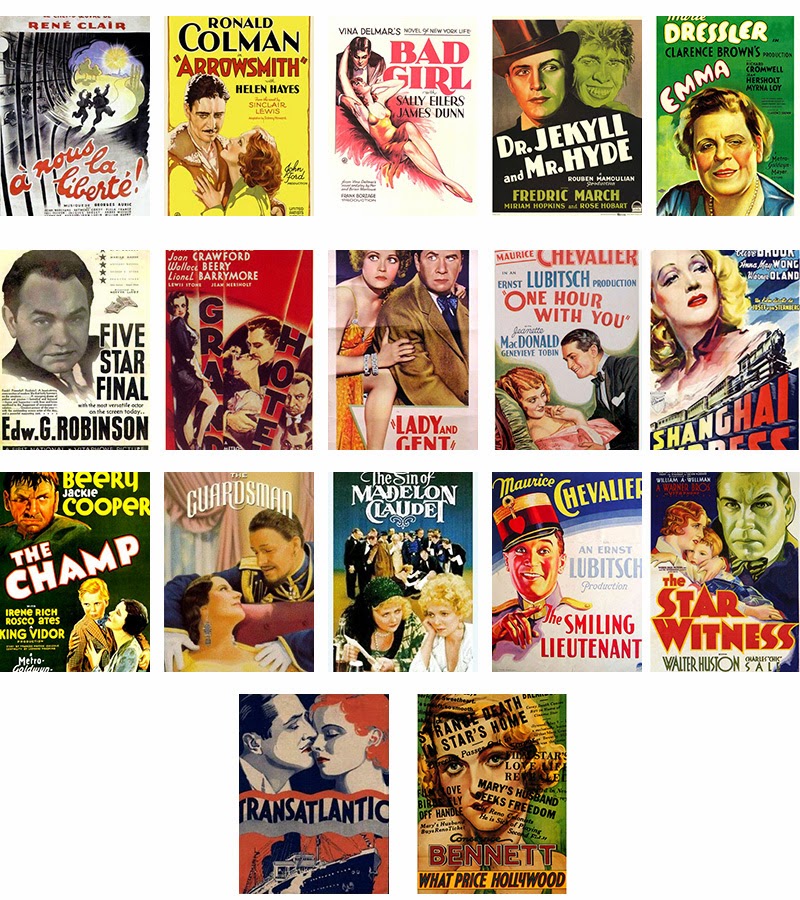
I’m not sure if it’s just me, but one thing I’ve really noticed about this era of cinema – the late twenties and early thirties – is that women owned the screens. From Norma Shearer to Gloria Swanson, Janet Gaynor and Clara Bow in previous years, the fifth Oscars really saw a surge in actresses remembered, imitated and emulated today. Greta Garbo, Joan Crawford and Marlene Dietrich all made a big splash this year in diverse and compelling roles, and some now lesser known stars, Marie Dressler, Helen Hayes, were equally strong. It was a golden era for women in cinema, and this year’s films gave them meaty roles to sink their teeth into.

Of course, there were some great men too – the Barrymores, Fredric March, James Cagney to name a couple, but the serious commanding presences like William Powell, Cary Grant, James Stewart, Marlon Brando, Gary Cooper were either still in small or supporting parts, or still a few years away from stardom.

It makes for an interesting commentary on the era and, even more so, an interesting point of reflection from now, where dark, smouldering women were a runaway favourite for leading roles.

Putting that aside, this is an interesting year for the Oscars for a few reasons. One it was the last and only time that a best picture winner would be nominated for no other award (a crime, to be honest, given the calibre of the winning film, Grand Hotel). It also saw a more determined swing away from historical and war films and towards romantic comedies – something that would be a staple for quite a few years to come. This year three of the eight Best Picture nominees were romantic comedies  and many of the other nominees were domestic or courtroom dramas. This is the first year since the start of the Oscars where not one war film was nominated, not necessarily a strange fact given the timing between world wars, but a remarkable one all the same.

While I won’t be reviewing short films at this time, hey! Short films entered the race this year with three categories – animated short, comedy short and novelty short. Also worth noting that this was the last year that Best Sound Recording went to a studio instead of an individual.

Three Films to Watch
Dr. Jekyll and Mr. Hyde. Maybe it’s my monster heart speaking, but I really do love this film. It’s one of the earlier monster films to be nominated, and has some amazing effects and a stirring, compelling performance from Fredric March in both the titular roles. He goes for it, and the film is nowhere near as camp as the genre and the era would allow for. It was dark and gritty before that was a staple of the form.

Shanghai Express.  Something you might not know about me – I love train movies. They can condense so much tension, so much drama through compartments and carriages in a way other settings struggle to replicate. Snowpiercer, Strangers on a Train, hell, even Unstoppable. Shanghai Express does it better than most, grounded in the remarkable performances of Marlene Dietrich and Anna May Wong. It’s terrific.

Grand Hotel. It certainly hasn’t been every year that the Best Picture winner has made this list, but Grand Hotel was one of the relatively few times that the Academy got it right. From the compelling and interweaving narrative, to the performance to some of the most impressive cinematography I’ve seen from this era of heavy cameras, Grand Hotel pretty much has it all.

Three Films to Miss
Bad Girl. While not a bad film, the sort of narrative of a young woman and man hating each other and then falling in love are really a dime a dozen.

One Hour With You. A fun romantic comedy, but Maurice Chevalier really bothers me as an actor. I find him smug, which sort of ruins the effect of this would-be charmer.


A nous la liberte. Look, it’s blasphemy, but I didn’t warm to this French satire on the nature of capitalism at all. 

Oscars 003

About  three years ago, I got it into my head to watch every film ever nominated for an Oscar. It's a pretty insane feat, given that the nominees are well into the thousands, but it's a project I'm yet to regret embarking on. It's just a hell of a lot of fun and has given me this sort of startling education in the history of cinema and narrative. While I've been watching films on an ad hoc, out of order basis over on tumblr, I am finally starting to be able to cross full years off my list, and as I do, I'll be recapping them here. 


If the first two years of the Oscars were representations of what was to come (while never straying too far from the norm), the third year was where things started to get interesting. From documentary, to war commentaries, strange science fiction, political dramas, ruined women and big budget aviation, 1930 was a year of diversity in cinema. 

Looking back too, it was a year that showcased some of the best actresses of the decade (and perhaps, all time) - particularly in Greta Garbo, Gloria Swanson and Norma Shearer who would continue to dominate for a few years yet. Norma Shearer, who won Best Actress for her dynamic turn in The Divorcee as a woman embarrassed by her adulterer husband becoming a woman about town herself to return the favour, is wonderful, and perhaps one of the more underrated actresses of the era. She'd actually be a little typecast in the role too, taking on similar ones in 1931's A Free Soul (for which she'd be nominated as well), Let Us Be Gay (1930),  Strangers May Kiss (1931) and Riptide (1934). 

It's a role similar too to the ones played by Greta Garbo in Anna Christie and Gloria Swanson in The Trespasser, demonstrating the few roles available to women of the era. These were each roles in which a woman was ruined and sought salvation in or from men. It makes for an interesting juxtaposition to the other roles women were nominated for - generally strong, weeping mother  roles, which lends a whole new weight to the idea of Madonna, Mother or Whore. (If you played the Madonna in this era, you certainly wouldn't get a nod for it).

On the other end of the spectrum is the building theme of disillusionment with war. There's a teetering balance between patriotism and anger at the scope of war, and the genre of war films could almost become its own category. From Wings (1928) which won Best Picture in the first ever Academy Awards through to All Quiet on the Western Front (1930) which won this year, you can see a dark plunge in subject matter. Wings was certainly critical of war, but All Quiet on the Western Front is brutal. It not only emphasises the tragedy of war, but highlights the futility of it, and the tendency for middle aged men to use boys like toy soldiers. It's a marked difference, and for the rest of the years, the Oscars will pendulum swing between hearty patriotism like The Patriot, War Horse and The Dirty Dozen and harrowing character studies like The Deer Hunter, The Hurt Locker and Apocalypse Now.

All in all, a really strong year for the Oscars, and one that really captures the start of cinema's diversification and the start of its attraction to shades of grey instead of just black and white. 

Three Films to Watch
1. All Quiet on the  Western Front. There's a reason this film is such a classic. It's wonderfully made, and both harrowing and compelling in its commentary on war. What makes it even more tragic is that this 1930 film still had World War II, Korea, Vietnam and Afghanistan ahead of it.

2. The Big House. One of the greatest prison films of all time, this film is darker than a lot of the films of the era and contains some amazing visuals across the board, from it's use of shadows and light, to its art department and its angles. 

3. Hallelujah. This film really surprised me. It was so rare to see one African American character in a film in the thirties, let alone to have a film with a full cast of them. It's a compelling film too, about religion and family and  love and lust. King Vidor's previous credits include the stirring film, The Crowd which embodies a lot of the same themes - particularly that of parent-child relationships, and he'd go on to direct War and Peace with Audrey Hepburn. His range is pretty amazing, and this is a really important film from his body of work. 

Three Films to Miss:
1. Disraeli. Suspiciously thin for a political film, this feels more like a Lifetime telemovie than an Oscar nominated feature.

2. Hell's Angels. A film that the biopic (The Aviator) is infinitely more interesting than the original subject matter. It's a well shot film, and the spectacle of it is impressive, just the plot is a little tedious, and the film is loooong. 


3. The Love Parade. Silly, sexist and kind of just bad. I can barely believe it was nominated so far across the board. 


Oscars 002


About  three years ago, I got it into my head to watch every film ever nominated for an Oscar. It's a pretty insane feat, given that the nominees are well into the thousands, but it's a project I'm yet to regret embarking on. It's just a hell of a lot of fun and has given me this sort of startling education in the history of cinema and narrative. While I've been watching films on an ad hoc, out of order basis over on tumblr, I am finally starting to be able to cross full years off my list, and as I do, I'll be recapping them here. 


It feels a bit like a cheat to be recapping the second Oscars at this stage. I've watched a fair chunk of the films, but of the 28 films nominated, four are considered lost films, and eight are unavailable in Australia, meaning I've watched 16 films and will still be casting some pretty wide aspersions in the process.

On the whole though, it was a year of pretty forgettable films. There was no real standout for me among them. That said,  there were some really great female performances, particularly from Greta Garbo, Jeanne Eagels, and Bessie Love, who all offered up diverse and compelling performances in roles that could all have quickly devolved to caricature. 

Interestingly, you can divide the films pretty easily into three categories: musicals, crime and shamed women. The latter was particularly prevalent - A Woman of Affairs, Street Angel, The Letter, Madame X, The Last of Mrs Cheyney all revolved around this idea of the salvation of bad women. It makes for an interesting trope in cinema and, perhaps even more interesting, was an era of female protagonists, which would slowly transition out as years went by. 

Three Films to Watch
1. The Broadway Melody. There were a lot of musicals nominated for Oscars in the second year, but The Broadway Melody is by far the best. It's hopeful, fun, and scaffolded with wonderful performances and some pretty delightful set pieces. 

2. A Woman of Affairs. Greta Garbo is, as always, a total star. Charismatic, gorgeous and insanely talented, she really was heads and shoulders above her contemporaries. Her performance in A Woman of Affairs is no exception, and it's worth it just for her. 

3. Street Angel. This one was actually nominated back in the first year and is the only movie to be nominated over more than one years. It's such a sweet little film too, and Janet Gaynor and Charles Farrell have such a tender, innocent chemistry. It's definitely worth the watch.

Three Films to Miss:
1. In Old Arizona. Boring, with an incredibly thin plot and riddled with racial stereotypes, it's worth the miss.

2. White Shadows in the South Sea. There are some interesting elements to this movie, particularly the colouring of the film, but the plot didn't do much for me and the protagonist was mostly an asshole. 

3. Alibi. Snooooooozze. 


The Oscars Project: 001


About  three years ago, I got it into my head to watch every film ever nominated for an Oscar. It's a pretty insane feat, given that the nominees are well into the thousands, but it's a project I'm yet to regret embarking on. It's just a hell of a lot of fun and has given me this sort of startling education in the history of cinema and narrative. While I've been watching films on an ad hoc, out of order basis over on tumblr, I am finally starting to be able to cross full years off my list, and as I do, I'll be recapping them here.

So, here we go. Oscars: Year One.

When we look at the first Oscars as a fledgling award, it's pretty hard to recognise as the same thing it is today. Actors could be nominated for more than one film (in fact, virtually all were), there were only 12 categories, and technical awards were nominated often not for any specific film, but to a studio or an individual for a suite of projects. It also, in a way that I kind of wish lasted longer than the one year, had two best picture winners. One for the best film (so, for technicality, performances, scope) and another for artistic production (so for smaller films with a bigger, say, emotional scope). 

That said, the richness of nominees isn't uncommon. There are gangster films, documentary, romance, philosophical narrative, adaptations and war films galore, all of which are strong indicators for both the future of cinema and the trends the Oscars will follow closely. As a whole, this is a strong start. At least as far as I can tell. 25 films were nominated among the 12 categories, but 10 of them are considered lost films. It, rather unfortunately, means that  the hard and tremendous work of the filmmakers is potentially lost forever, and, on a more personal note, means I'll never be able to fully watch the films nominated for this first year.

But hey, we should be thankful for the fifteen that are available! And they're mostly a good bunch. Janet Gaynor is particularly on show. As the winner of the first Best Actress award, she was up for three films, Sunrise: A Song of Two Humans, Seventh Heaven and Street Angel - all of which are pretty darn stellar films, and showed off Gaynor as one of the talents of her generation.

Unfortunately the first Best Actor award isn't such an easy one to appreciate. Emil Jannings was the winner, who gave brilliant performances in The Last Command and The Way of All Flesh. His win though has been all but revoked after Jannings (who you may remember being satirised in Inglourious Basterds) became embroiled in the Nazi Party during World War II and then one of the most recognisable faces in Nazi propaganda films. (Yikes, am I right?)

The awards are also pretty cool/sad, because it's a pretty clear signifier for the end of silent film. The Jazz Singer was up for a writing award in it, and was the first film to ever include sound. By the second year, while there were still a few stragglers, audio had infiltrated most of cinema in what's a pretty quick turnaround (especially when you look at how slow it took colour to catch on, but let's leave that til later awards), and the effect is a bit disheartening given how brilliant some of these films are, but hey, more on that below.

Also worth noting is that Charlie Chaplin received an honorary award. Huzzah!

Three Films to Watch
1. Sunrise: A Song of Two Humans. Dark, uplifting and unsettling all at once, Sunrise is the story of a woman who convinces a man to murder his wife so that she can marry him and receive his inheritance. The concept is a simple one, but edges a maliciousness into every scene that left me uneasy like Lynch and Fincher would succeed in doing much later. Awesome, awesome film.

2. Sadie Thompson. I hummed and harred about recommending this one as the final reel of the film is actually missing. The DVD I've got has reconstructed it with stills and speech cards, but it means that the guts have really been torn out of the film's climax. That said, the first two thirds are so brilliant, so compelling, I couldn't resist. Gloria Swanson is one of my favourite actresses of the era, and she is on point in this film as a prostitute trying to rehabilitate her life and finding herself fighting a crazed priest in the process.

3. I was really unsure about this final slot. There are a lot of good films this first year, from early gangster film, The Racket, Russian political film, The Last Command, to brilliant social-isolation narrative, The Crowd. That said, there's only one of all of these I've watched more than twice now, and that's Seventh Heaven, an odd little romance about a street cleaner who falls in love with a woman thrown out by her sister. Janet Gaynor won the first ever Best Actress award for her emotive and gorgeous performance as Diane (she was always nominated for Sunrise and Street Angel - two other great films). It was also an early pair-up film of hers with Charles Farrell. They'd be love interests in over 15 films in both of their careers, and it's easy to see why. Their chemistry is basically off the charts.

Three Films to Miss:
1. A Shop Comes In. A total snooze-fest. That is all.

2. The Jazz Singer. Look, I know, I know. It was the first film to include sound. That's great and all, but there's only sound for like, one song, and it's not even a good song, and it's especially not enough to make up for the gratuitous racism and the really lackluster script (whhhhyyy was it nominated for a writing award?)

3. Is a write-off this time. All the others were pretty good, but if you don't like romantic comedies, miss Speedy, or if you don't like crime, maybe write off Underworld (but that film's pretty great, so maybe not).